Somewhere behind the oat milk is a bag of spinach you bought with big plans on Sunday. By Thursday it’s wilted at the bottom of the drawer.
That happens in almost every kitchen. The U.S. Environmental Protection Agency estimates that wasted food costs the average American about $728 a year, or roughly $14 a week, per person. (Here’s what that adds up to for a household your size.) Most of that isn’t food anyone chose to throw away. It just slipped out of sight.
A kitchen inventory fixes the forgetting. The trouble is that most inventories last about nine days, because they take more effort than they give back. Here’s a version that holds up in real life.
Why most kitchen inventories fail
They try to track everything. A full audit of every spice jar feels productive for one evening and then turns into a chore you’ll abandon by Thursday.
They also get updated at the wrong time. If the plan is “I’ll update the list on Sunday,” the list is wrong from Monday to Saturday, and once you stop trusting it, you stop looking at it.
So keep the rules short: track less, record it sooner, and sort by what needs eating.
Step 1: Decide what’s worth tracking
You don’t need to know how much salt you own. Track the things that cost you money when you forget them:
- Fresh food with a short life: leafy greens, berries, herbs, mushrooms, fresh meat and fish.
- Opened things: the half jar of pesto, the cream you used two spoonfuls of.
- Leftovers: they’re the easiest meals you’ll ever make, and the easiest to lose.
- The freezer: food stays safe there for a long time, which is exactly why it gets forgotten.
- Pantry items you tend to double-buy: the stuff you keep re-buying because you can never remember if you’re out (coconut milk, canned tomatoes, cumin).
Everything else can stay untracked until it causes a problem.
Step 2: Record food when it comes home
The best moment to update your list is the two minutes after you get back from the store. Everything is on the counter, the receipt is in your hand, and you still remember what’s in the mystery bag from the deli counter.
Pick the method you’ll actually use:
| Method | Good for | Watch out for |
|---|---|---|
| Whiteboard on the fridge | Small kitchens, people who live alone | You can’t read it from the store |
| Shared note or spreadsheet | People who like a tidy list | Typing every item gets old fast |
| An inventory app | Reminders, sharing, and checking from anywhere | Only works if adding food is quick |
Whatever you choose, keep each line simple: what it is, how much, and roughly when it should be eaten.
A tip for dates: you don’t need the exact day. “This week,” “next week,” and “whenever” cover almost every decision you’ll make at 6pm.
Step 3: Sort by “use first,” not by food group
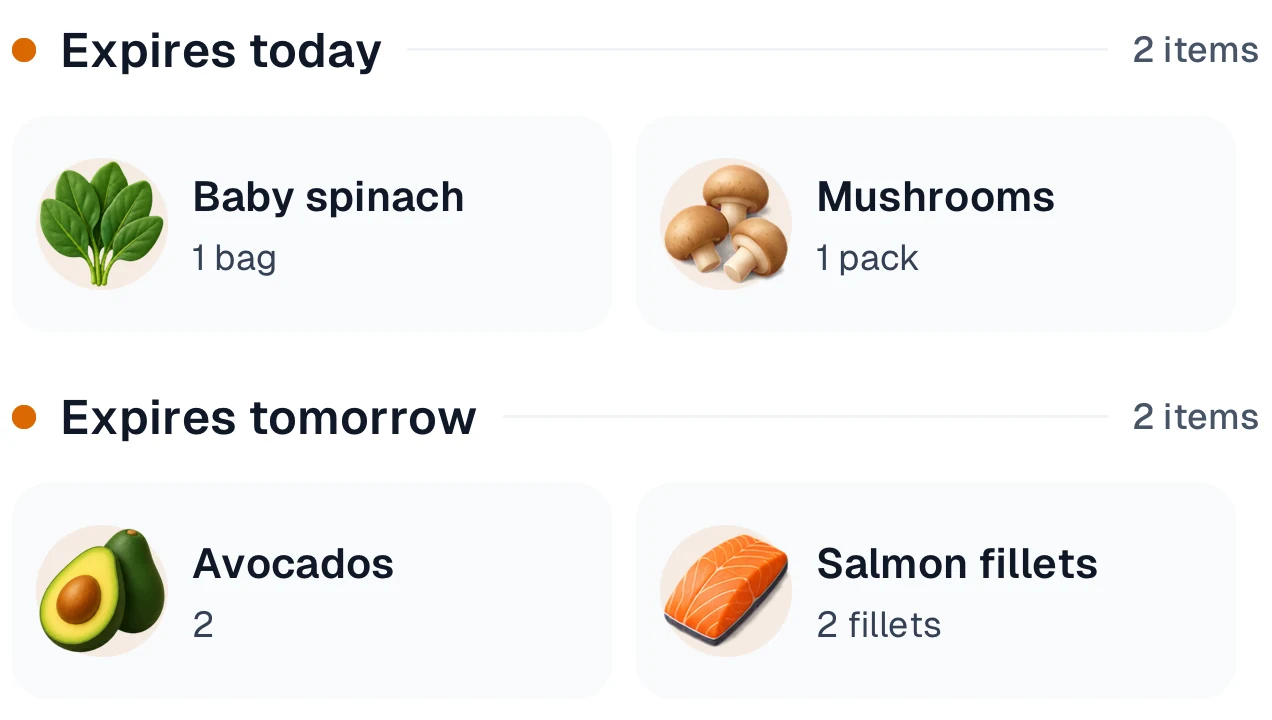
Sorting by food group (dairy, produce, meat) tells you what you own. Sorting by expiry tells you what to cook tonight.
Put the food that’s running out of time at the top. If you only glance at the first three lines each evening, you’ve already won.
Here’s the difference, with the same eight foods. Flip the switch:
Sorted by “use first”: dinner is the top of the list
A sample fridge. The same eight foods, listed two ways.
Use today or tomorrow
 Chicken thighs1 day left
 Spinach1 day left
 Salmon2 days left
Use this week
 Strawberries3 days left
 Milk6 days left
No rush
 Greek yogurt12 days left
 Carrots14 days left
 Cheddar21 days left
Restaurants call this “first in, first out.” At home it’s even simpler: when you unpack, slide older food to the front of the shelf and put the new food behind it. Your eyes do the rest.
If you’re unsure how long something keeps, these are the ones worth memorizing, from the cold food storage chart at FoodSafety.gov:
How long it keeps in the fridge
Days after you buy, cook, or open it. Whatever the package says, eat it or freeze it before the second part of the bar runs out.
 Raw ground meat1 to 2 days
- Raw chicken and turkey1 to 2 days
 Cooked leftovers3 to 4 days
 Raw steaks, chops, and roasts3 to 5 days
 Opened lunch meat3 to 5 days
Eggs in the shell are the patient ones: they keep 3 to 5 weeks. In the freezer, at 0°F (-18°C), the clock stops for all of these.
Source: FoodSafety.gov, Cold Food Storage Chart. General guidance for a fridge at 40°F (4°C) or below.
Date labels help too, once you know what “best by” and “use by” really mean.
Step 4: Do a five-minute reset each week
Pick a regular moment, ideally right before you write your shopping list:
- Open the fridge and compare it with your list. Remove what’s gone, add what snuck in.
- Pull anything that needs eating in the next two days to the front.
- Plan one or two meals around those things. Our guide to cooking with what you already have has a method for this.
- Write the shopping list last, so you only buy the gaps.
Five minutes. That’s the whole maintenance plan.
Step 5: Make it the household’s list, not yours
An inventory that lives in one person’s head (or one person’s phone) breaks the moment someone else finishes the eggs. If you share a kitchen, share the list:
- Keep it somewhere everyone can see and change.
- Agree on one rule: if you finish it, take it off. If you open it, say so.
- Let anyone add to the shopping list, so “we’re out of milk” stops being a 7am discovery.
Where Noshby fits
We built Noshby for exactly this problem. It handles the parts of this system that are easy to skip:
- Adding food takes a photo. Snap your groceries or the receipt and Noshby reads what you bought and sorts it into fridge, freezer, and pantry.
- It sorts by what expires first and reminds you before food turns, so you don’t have to check.
- It suggests dinner from what’s in your kitchen, and shows how many ingredients you already have for each recipe.
- Your household shares one kitchen, with one shopping list everyone can add to.
You can run this whole system with a whiteboard and a marker, and plenty of people do. What matters is the habit: track less, record sooner, and eat from the top of the list.